
Read Lincoln County Property Tax Records
Reading these records means joining two offices. The assessor fixes value and class. The collector bills, collects, and flags delinquency. A parcel number or PPIN bridges the two sides best, though a name or address can start the lookup as long as each result gets matched to the correct piece of land in Lincoln County.
| Field | What It Shows | Where |
|---|---|---|
| True or market value | Assessor's full-value estimate | Tax Assessor appraisal roll |
| Assessed value | True value after the class ratio | Assessment roll |
| Exemption | Tax relief applied through a separate process | Tax Assessor |
| Bill and payment | Tax due, installments, and status | Tax Collector |
| Delinquency or sale lead | Unpaid real estate or special assessments | Collector and sale notice |
Mississippi starts with true value. It then applies an assessment ratio and millage. Class I owner-occupied residential real property generally uses 10 percent, Class II real property uses 15 percent, and a tax amount never equals a sale price.
Lincoln County Property Tax Search Fields
The Lincoln County real-property tax search lists alternative query fields. Test one identifier at a time.
| Field | Observed format | Best use |
|---|---|---|
| Name | Last name, first name | Owner lead |
| Address | Number and street | Situs search |
| Parcel number | Text identifier | Direct parcel match |
| Section, township, range | Separate land-grid fields | Rural land |
| PPIN | County property key | Cross-system check |
The manifest capture below comes from the official tax form.
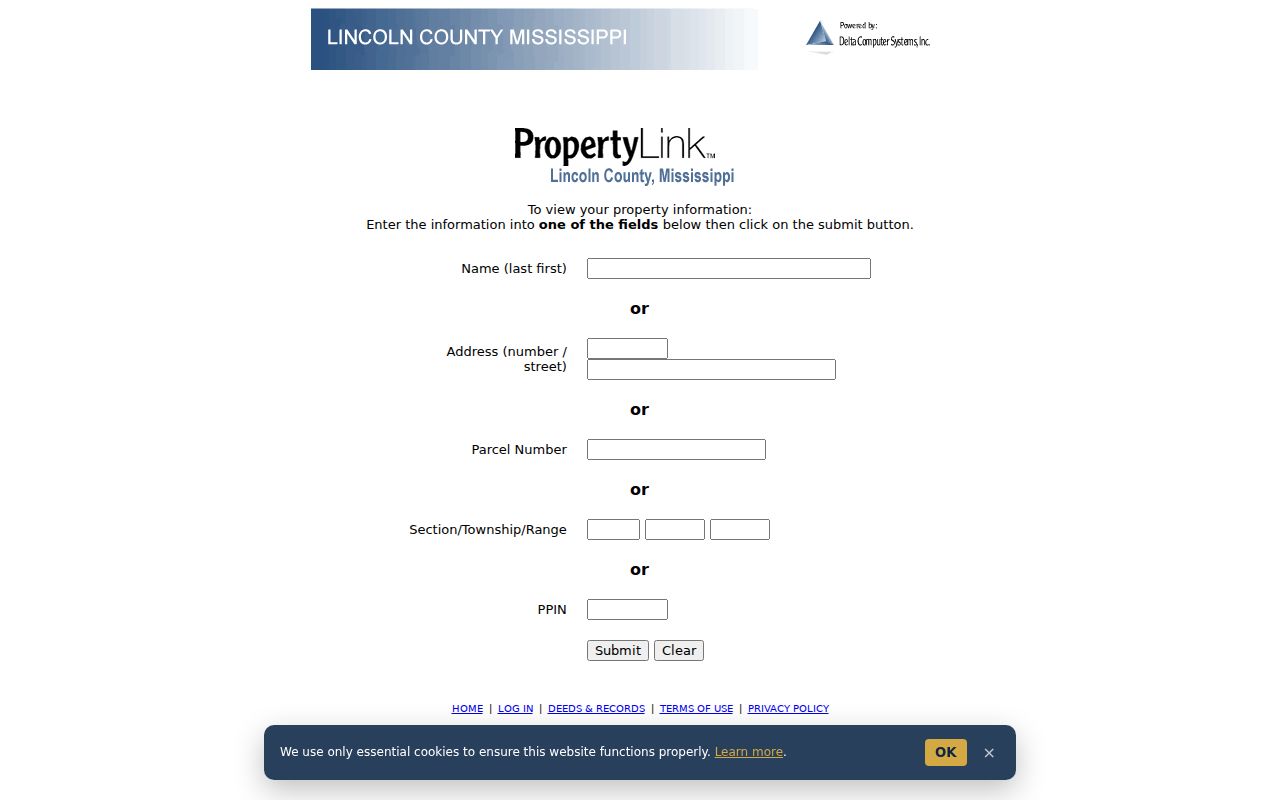
Query choices are all the form shows, with no sample bill or value card published alongside them.
Lincoln County Assessment Calendar
Mississippi law requires a reappraisal at least once every four years. The assessment roll then opens for public review. Objections generally must reach the board of supervisors by the first Monday in August, so confirm the current year's meeting notice and filing instructions before acting.
Owners should gather the parcel record, photos, measurements, classification facts, and valuation evidence early. A recent deed can explain a sale. It still does not control the assessor's mass-appraisal result.
Appeal deadline. Confirm the current first-Monday-in-August Board of Supervisors schedule with the Lincoln County Tax Assessor before submitting an objection.
Homestead on Lincoln County Tax Records
Homestead exemption is not a deed. It changes tax treatment, never title. Applications go through the Assessor between January 2 and April 1, and the Mississippi Department of Revenue explains eligibility, the sworn application, and change-of-status duties.
Check the exemption year first. Compare bills from the same tax year. Different exemption or class treatment can produce different taxes even when the appraised figures sit close together.
Note: An exemption changes tax treatment and should never be presented as evidence of market value or legal ownership.
Look Up a Lincoln County Tax Bill
The Tax Collector holds the primary tax records. The web search works for a current lead, while the office answers certified, historical, installment, and delinquency questions.
- Search by parcel number or PPIN, then use address or name only when needed.
- Confirm the tax year, amount, payment status, and parcel identifiers.
- Compare classification and exemption information with the appraisal record.
- Contact the Collector before treating a delinquency entry as a sale or loss of ownership.
- Assessed value
- The statutory portion of true value used in the tax formula.
- Millage
- The rate applied to assessment to calculate tax.
- Homestead exemption
- Approved relief that may reduce an eligible owner's tax burden.
- Tax lien
- A public claim arising from unpaid tax, distinct from a completed conveyance.
Lincoln County Real-Tax Installments
The Lincoln County Tax Collector allows real-tax installments. The first payment must reach at least half the amount due by February 1 following the tax year. Each later installment adds one percent monthly interest. Confirm the current balance before calculating a payoff. Call the Collector at 601-835-3427, because a portal display can lag a payment or leave a historical certification question open.
From Lincoln County Delinquency to Tax Sale
Unpaid real estate taxes and special assessments feed an advertised annual tax sale. The sale generally lands the last Monday in August. Redemption runs two years afterward. A sale is not clear title. The Secretary of State offers a new tool. Its tax-forfeited inventory map, launched May 23, 2025, searches by county, parcel number, PPIN, or drawn area and shows active applications. In Lincoln County, check the Collector record too. Also confirm the legal description, redemption status, and later Chancery instruments before drawing any conclusion about a parcel.
Note: the inventory map is a starting point, not proof that a parcel is available or that its title is clear.
Brookhaven and Wesson Property Tax Jurisdiction
Brookhaven parcels follow the county assessor and collector path. City and district context still needs a separate check. Wesson straddles Lincoln and Copiah counties. A Wesson postal label alone cannot pick the correct tax office, so locate the parcel and its county side first and preserve its PPIN, taxing districts, and situs fields. The Wesson real estate records page explains why the county check comes before a town-name search.
Keep Lincoln County Tax Years and Record Dates Together
A parcel's tax trail gathers several dates. The assessment year, payment due date, posting date, advertisement date, sale date, and redemption events all sit near one another. Copy a dollar figure without its year and a correct record turns misleading. Preserve the PPIN beside every entry.
The public tax form states no historical coverage cutoff. For a multi-year ledger, receipt, or certified status, ask the Collector which years are online and which live only in the office. A missing web row proves nothing. A bill, payment, or older record can still exist on paper.
The appraisal and tax screens answer different questions. The appraisal side explains classification and the value used in assessment. The Collector side explains billing, installments, payment, and delinquency. Deeds and tax rolls update on different schedules. Compare the two sources by parcel and year, not merely by owner name.
Verify a Lincoln County Tax-Sale Record Chain
A tax sale never stands alone in Lincoln County property records. It is one event in a longer public trail. Begin with the Collector's delinquency and advertisement material. Pull the exact legal description. Confirm whether redemption ever occurred. The parcel may later pass into the Secretary of State's inventory. Save the state application status and land-representative details too.
From there, move to the Chancery records. Search for a tax deed, state patent, later conveyance, correction, or court filing. Each must tie to the same property. A name in a notice proves little by itself. The legal description and the recorded instruments are what actually control ownership.
Older Lincoln County tax-sale material also lives elsewhere. The Mississippi Department of Archives and History finding aids hold it. That route helps when the web tax form stops short of the year you need. Still, an archive reference only counts one way. Connect it back to the county deed and parcel trail.
Request Lincoln County Tax Records Offline
Tax Assessor Blake Pickering works from Room 109 of the Lincoln County Courthouse at 301 South First Street in Brookhaven. His office answers at 601-823-9347. The Tax Collector can be reached at 601-835-3427. Direct each question to the office that actually holds the record. A broad request to the wrong clerk usually stalls.
A written request under the Mississippi Public Records Act should name the parcel. It should also cover the tax year, the record you want, and your preferred format. Direct costs may apply. The response framework runs seven working days when written procedures exist and one working day when they do not. Production itself can lag behind that. For the assessment roll, ask the Assessor. For bills, receipts, payment history, or sale status, ask the Collector. A deed or redemption instrument belongs with the Chancery Clerk instead. Split the request by office. That keeps a payment record from being mistaken for proof of ownership.
Certified and historical questions often require the courthouse trip. The public tax page sets no coverage cutoff. List the owner name only as a secondary key. A parcel number, PPIN, tax year, and a legal-description clue make the request far more precise.
Contest a Lincoln County Property Assessment
Start with the Tax Assessor. Verify the class and the facts on the roll, then ask how to submit an objection for Board of Supervisors review. Keep the current notice and deadline close at hand, because a generic calendar can never replace the county's live instructions.
Appeal window. Mississippi's schedule points to the first Monday in August, but the owner must confirm Lincoln County's current deadline and procedure before filing.
Aim the objection at classification, property characteristics, and valuation evidence. Ownership disputes belong in deed or court records. A tax-bill payment question belongs with the Collector. Keep a copy of the filed objection. Save every supporting exhibit and any written response you receive. When the error concerns acreage, improvements, or parcel identity, state it precisely. Attach the record that proves the correction. If the fight is only over what a value means, keep that issue separate. The calculation of the bill is its own matter.
Ask how the Board will accept documents and whether the owner must appear in person. After the decision, preserve any revised record. Then compare the Collector's later bill. Confirm the approved change landed on the correct parcel and tax year. File the final notice with the property file.