
Build Lincoln's Former-Owner Timeline
Open with the newest matching deed. Each row of the timeline should capture the filing date, who conveyed to whom, the instrument type, and the record citation. That discipline pays off. It keeps an assessor label or a shared surname from masquerading as a proven ownership link.
| Transfer date | Grantor to grantee | Deed type | Book/page or instrument |
|---|---|---|---|
| Newest filed date | Prior owner to current grantee | Read exact index label | Copy the complete citation |
| Earlier filed date | Earlier grantor to later owner | Warranty, trustee, tax, or other | Verify against the deed image |
| Archive period | Names from the prior deed | Lettered deed-book entry | Book, page, and MDAH roll |
A grantor conveys an interest. A grantee receives it. The chain of title is the ordered set of instruments affecting the same land, not a roster of everyone who ever lived at the address. Keep owner names, capacities, legal descriptions, and citations together in one record.
Find Lincoln's Latest Grantee
Use the assessor or GIS map only to frame the parcel: owner lead, PPIN, situs, map number, acreage, subdivision, and deed reference. Then search the Lincoln County deed index with that owner as grantee. The match must be to the land. A shared name proves nothing. Try entity, trust, estate, spouse, and spelling variants. Narrow a long results list by filing date, instrument type, section-township-range, subdivision, block, or lot. A corrective deed can repeat parties without new ownership. The official deed-index screen displays the party, record-reference, date, and land-description controls used to trace prior owners.
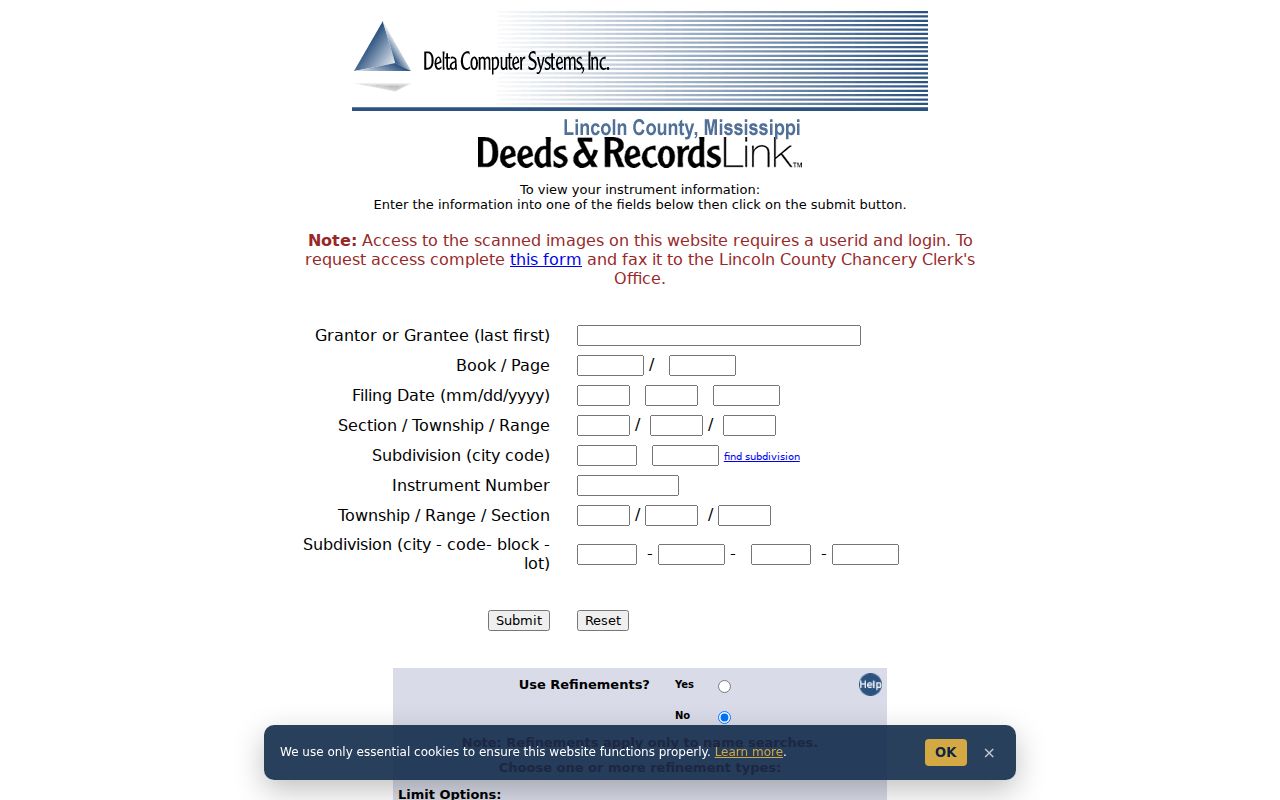
The image shows the county's grantee search form itself, where a name can be entered. It is not a former-owner result or a title conclusion.
Translate Lincoln's Old Addresses
Prior owners may have known it by rural route. An old road name, a community, or a section call worked too. A later E911 address often differs from the deed. Street trails break. Save every known form. If the street trail fails, search the legal description. Use it instead of the address on old tax receipts, probate papers, and newspaper notices.
The E911 Coordinator handles current address questions and road context. Historic Brookhaven maps from 1959, 1974, 1978, 1985, 2007, and 2008 can flag road or corporate-limit changes. They prove nothing about ownership.
Reverse Lincoln's Deed Chain
Backward tracing turns each seller into the subject of the next earlier search. Always read the deed image. Abstracts can omit exceptions, reservations, authority language, and marginal releases.
- Find the latest purchase deed with the current party listed as grantee.
- Copy the prior grantor, full legal description, record stamp, and cited prior deed.
- Search that grantor as an earlier grantee and confirm the same tract.
- Review intervening releases, probate papers, partitions, tax deeds, and corrective records.
- Transfer the citation to the archive guide when the web index no longer reaches the date.
- Reverse index
- An index arranged to find the party receiving title.
- Legal description
- The land description that ties different names to one tract.
- Quitclaim deed
- A transfer of whatever interest the grantor may hold.
- Warranty deed
- A conveyance with stated title promises.
Note: Keep the deed recording date separate from the appraisal access date. Lincoln County publishes no roll-update lag.
Lincoln Deed Books Reach 1810
The public portal states no online cutoff. The MDAH Lincoln microfilm guide documents deed-index and book holdings from February 1810. That date predates Lincoln County's 1870 creation. An early record may reflect a predecessor jurisdiction or a record-series quirk. Index rolls 134 and 135 cover surnames A through O and P through Z from 1810 through 1907, while later volumes continue through July 1988 on rolls 262 through 270 and A-6618 through A-6619. Deed books begin on roll 136. Pick rolls by date and book.
Online cutoff unknown. Older Lincoln County former owners remain researchable through deed books and microfilm, but no official source states how far the current web index reaches.
Probate Bridges Lincoln Ownership
Estates break the simple buyer-seller pattern. Lincoln County's archive guide separates wills, inventories, estate sales, executor or administrator bonds, settlements, and loose Chancery records, plus loose papers from 1850 through 1920 that may explain partitions, title disputes, and inherited interests. Search the deceased owner's name, the executor or administrator, heirs named in filed instruments, and the eventual grantee. An obituary can suggest dates and kin. A cemetery entry can too. Neither proves heirship, so bring every clue back to the probate and deed records.
Verify Lincoln's Fire-Era Series
A local genealogy source reports an 1893 courthouse fire with partial survival of earlier land and estate records. Do not read that as a blanket gap. Check the exact deed book, index volume, probate series, or loose-record range in the MDAH guide. MDAH's digital Lincoln records include an 1889 land series. The original-record finding aid also names 1879 tax-sale land instruments and an 1875 power of attorney. These are leads, not a chain. Neither replaces a complete chain.
Plats Keep Lincoln Parcels Stable
A plat preserves the subdivision, phase, lot, block, courses, monuments, streets, easements, and recorded book-page link that outlast any street-name change. Lincoln GIS adds subdivision, lot, deed, and acreage clues. Compare the deed against the recorded plat. A GIS polygon is not a survey. When acreage, lots, or metes-and-bounds calls shift, hunt for a split, merger, boundary-line agreement, exception, or corrective deed. Assign owners to the later shape only then.
Use Lincoln Newspaper Clues Carefully
Old newspapers can tie a past owner to a date, an estate, or a tax sale. They can also surface a foreclosure notice or a public auction. The Lincoln-Lawrence-Franklin Regional Library archive offers Brookhaven Semi-Weekly Leader issues from 1906 through 1922 as online PDFs. Branch microfilm is also available. Mississippi State University also holds runs of the Brookhaven Democrat, Brookhaven Leader, The Leader, Lincoln County Times, and Daily Leader. These are organized by title and date.
Search a surname you know, a road, a subdivision, or an executor's name. A legal-notice date works well too. Then treat the notice only as a pointer toward the official deed, probate file, or court record. The same goes for a tax-sale instrument. Newspapers report events and planned actions. They cannot prove a conveyance closed or that redemption never happened.
The Library of Congress catalog dates the Lincoln County Times from 1889 through 1948. A notice sitting near an archive gap can narrow your search window. Before heading back to Chancery records, note the issue title, date, page, names, land wording, and cited proceeding.
Tax-sale material needs stage labels as well. An advertisement, a sale, a redemption, and a state forfeiture are separate events. A patent and a later conveyance are separate events too. Lincoln County's Collector material, a newspaper notice, and a Chancery instrument may each describe a different stage. The Mississippi Secretary of State inventory may describe yet another stage in the same parcel's history. Placing a bidder in the former-owner chain takes a recorded conveyance plus later history that supports it.
Census records and local photographs can round out a house history. But residence and ownership are different things. Federal population schedules are public only through the 1950 Census under the standing release rule. A boarder or relative listed at an address may never have held title. Keep these contextual sources separate from the deed-backed chain.
How Far Lincoln Owners Go
The documented archive path in Lincoln County reaches back to February 1810. That date is not a promise of an unbroken chain for every tract. Book gaps, shifting jurisdictions, and altered descriptions can all force you into added sources. Estate transfers and tax or court proceedings can do the same. Ask the Chancery Clerk about current records. Turn to MDAH for the relevant historic roll or original-record series. The Lincoln-Lawrence-Franklin Regional Library rounds things out with Brookhaven newspapers. Its holdings also include microfilm, obituaries, photographs, and local history. Newspaper notices can pin down dates and party names. Yet they remain discovery aids rather than substitutes for the recorded deed or court order.
Lawful use. Research on Lincoln County former owners supports house history, estate work, and purchase diligence. Never use ownership records to stalk, harass, or target a living person.
To trace one specific recorded instrument or order copies, start with the Lincoln County deed records page. For breaks in the chain, conflicting legal descriptions, or any doubt about who held proper authority, a title professional is the right person to sort it out.