
Lincoln Deed Types Decoded
Deeds in Lincoln County live with the Chancery Clerk. A deed records the transfer of an interest in land. A deed of trust, lien, release, or lis pendens plays a different role entirely. The instrument type tells you why a name appears. The full document and its legal description control the reading.
| Deed Type | What It Does | Common Use |
|---|---|---|
| Warranty deed | Conveys land with stated title promises | Ordinary sale or transfer |
| Quitclaim deed | Conveys only the interest a grantor may hold | Family or corrective transfer |
| Trustee or executor deed | Shows a fiduciary acting in a named capacity | Trust or estate transfer |
| Sheriff or special-master deed | Reflects authority from a legal process | Judicial transfer |
| Tax deed | Records a tax-sale-related conveyance | Distressed-property chain |
The Lincoln County Chancery Clerk also records mortgages and deeds of trust, construction and condominium liens, federal tax liens, lis pendens, military discharges, and indexes. Deeds are only part of the record room. An encumbrance is a claim or burden on land. It is not a conveyance. Releases and substitutions of trustee show what later became of an older claim.
Lincoln Deed Index Fields
The Delta land-record index opens several doors into Lincoln County deed records, including party name, book and page, and instrument number. Refine a party search by role and time.
| Index area | Fields | Use |
|---|---|---|
| Party | Grantor or grantee, last and first | Find a conveyance by name |
| Reference | Book/page or instrument number | Open a cited record |
| Time | Filing date and ranges | Narrow a recording window |
| Geography | Section-township-range or subdivision | Match rural or platted land |
| Lot | City code, block, and lot | Check an urban description |
Filing date marks when the clerk received an instrument, not necessarily when it was signed. Filters can narrow the field by instrument type, grantor or grantee role, or book. You can also filter by date or instrument number. Try trusts, estates, and entity names too. The Lincoln County deed index shows these controls. The Delta page presents them before any party query runs.
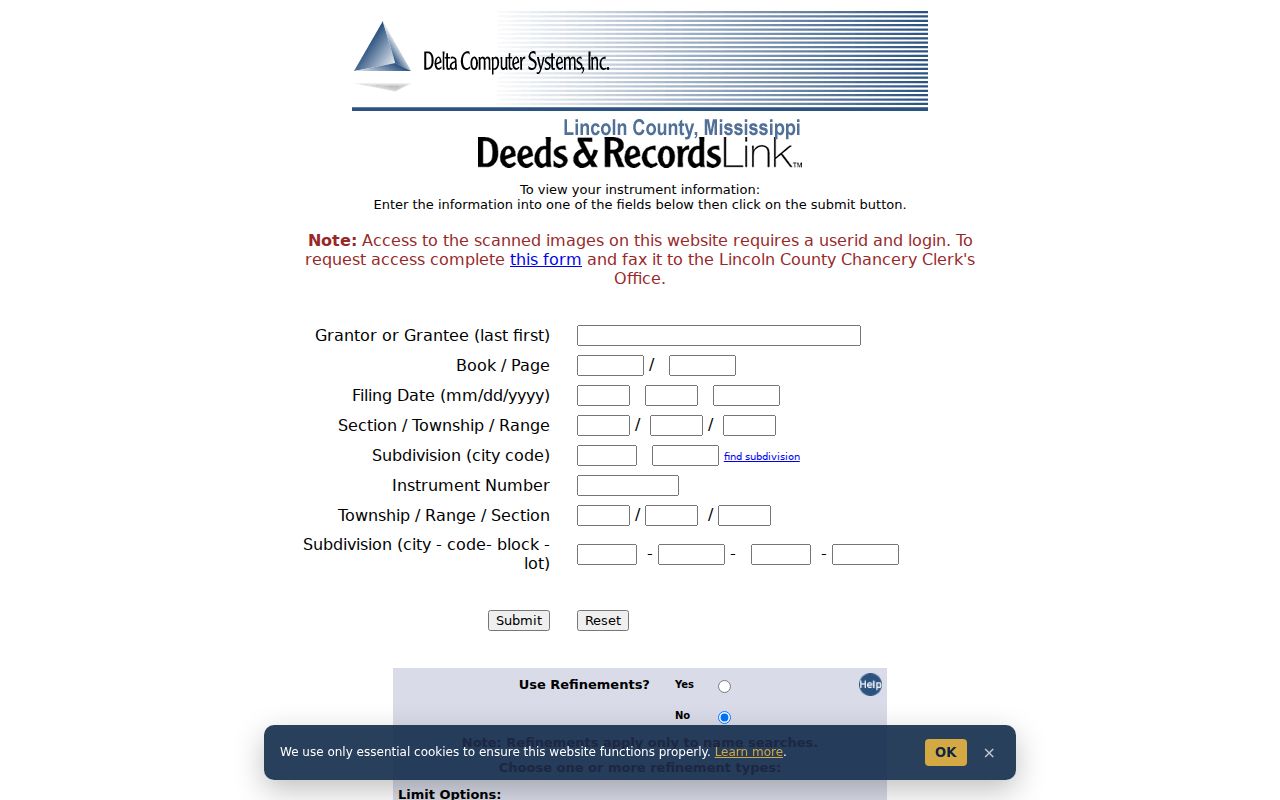
The page confirms image-login rules, and the courthouse remains official.
Lincoln Images Need Credentials
Searching Lincoln County's public deed index is open to anyone. Pulling scanned images is different. That step takes a user ID and password. The clerk issues these after you complete the Internet Record Room form. The form asks for contact details, a purpose for access, the credentials you want, and a signature. It then goes by fax to 601-835-3423. For access questions, call 601-835-3452 or 601-835-3416.
Do not confuse this credential form with a deed-copy order. The official sources publish no schedule of image or copy fees. So ask the chancery clerk about current charges before requesting anything. Whenever the online Lincoln County property records lag or omit material, the deed recorded at the courthouse is what controls.
Walk Lincoln's Grantor-Grantee Chain
A grantor conveys an interest in land. A grantee receives it. Start with the most recent plausible buyer, make the prior seller the next search subject, and repeat only after the legal description confirms the same parcel.
- Find the current party's purchase deed with that party as grantee.
- Read the grantor, capacity, legal description, recording stamp, and prior deed reference.
- Search that grantor as a grantee in the earlier period.
- Check corrective deeds, releases, partitions, and estate instruments between transfers.
- Move to deed books or microfilm when the web search ends.
- Grantor
- The party conveying the stated interest.
- Grantee
- The party receiving it.
- Chain of title
- The ordered sequence of instruments affecting the same land.
- Book and page
- A volume-and-page citation.
- Instrument number
- A unique recording reference.
Lincoln Deeds Before the Web
How far back does the online search reach? The system never states its earliest year. The MDAH Lincoln County microfilm guide maps the older route. Deed indexes begin in February 1810, twenty years before Lincoln County itself was created in 1870, so early entries may belong to a predecessor jurisdiction or a different record series.
Indexes A through O and P through Z cover February 1810 to December 1907 on rolls 134 and 135. Later volumes run from January 1908 to July 1988 on rolls 262 through 270 and A-6618 through A-6619. Lettered deed books begin on roll 136. These ranges guide a request. They do not promise that every page survived.
Fire-Era Lincoln Record Checks
A local genealogy source reports an 1893 courthouse fire and says some older land and estate records survived. Treat that story as a lead. Test the exact year and record series against MDAH's deed, probate, tax-sale, and loose Chancery holdings.
Loose Chancery records run from 1850 through 1920. They can bridge estates, partitions, disputes, and title-confirmation matters. A selected MDAH digital set includes an 1889 land series. It is not a complete deed index. A chain crossing the fire year does not mean a whole era vanished.
Plats Clarify Lincoln Deeds
A plat maps a subdivision. Lots, blocks, streets, and related features all appear on it. Lincoln GIS fields can supply subdivision, lot, map, deed, and plat references. Brookhaven's final-plat rules require the owner, record book and page, legal description, acreage, monuments, courses, lots, setbacks, covenants, and utilities.
Use the map reference to find the recorded plat. Then compare it against the deed. A neighborhood nickname or a web-map outline cannot replace the recorded description. Boundary certainty may still take a licensed survey. Legal review helps too.
Lincoln Estate Deed Detours
A former owner can vanish from an ordinary sale sequence. Land often moves through an estate, trust, partition, or court order. Search administrator and executor deeds. Trustee deeds, affidavits, and appointments of trustee belong in the same hunt. Special-master instruments belong there too. The capacity beside a name explains why that party signed.
Lincoln County Chancery Court handles estates and land disputes. It also handles title confirmation. Older loose records from 1850 through 1920 appear in MDAH's guide. When an executor deed cites a cause, locate the probate or Chancery file first. Then return to the recorded conveyance. Probate explains the authority. The deed carries the land description forward.
Search the decedent, executor, administrator, heir, trust, and business-name variants. Confirm each candidate with the same subdivision, section, and acreage. Then match the cited prior record.
Audit Lincoln Record References
Start with the state parcel layer. It reports deed and plat dates, references, the tax map number, section, subdivision, and acreage. Treat those values as leads. Then set them beside the deed image and the clerk's own index. A filled-in field is not the same thing as the recorded instrument.
Pull the full record from the deed itself. That means the recording stamp, book and page or instrument number, every party, each capacity, and the complete legal description. Read for exceptions, reservations, rights-of-way, and earlier citations. When a deed conveys part of a larger tract, trace both the parent and child descriptions. Otherwise an old owner's big parcel can be mistaken for the modern shape of the land.
Context decides what a deed means. Tax deeds, sheriff's deeds, and special-master deeds all turn on legal process, redemption status, notices, and any later corrective records. Get a title opinion if authority is disputed, a link is missing, descriptions clash, or a tax sale stands between two records.
Platted land has its own vocabulary. Look for the subdivision name, phase or addition, lot, block, plat book and page, and any restrictions or easements stated on the plat. Rural property in Lincoln County leans on section, township, range, quarters, courses, distances, monuments, roads, and adjoining owners instead. Copy the whole description every time. A short tax-map label cannot carry the exceptions and reservations that define what actually changed hands.
A failed reference is a puzzle, not a wall. Search both party roles. Widen the filing window. A deed can be signed years before anyone records it, and the indexer may have used initials, a former business name, a marital form, or a fiduciary title. Once a plausible row appears, compare every geographic clue, then read the document itself. This measured approach is slower than grabbing the first matching surname. It also keeps unrelated Lincoln County deeds out of the chain of title.
The archive rolls can rescue a historic lookup. Register of Deeds index volumes 1 through 3 span February 1810 to December 1907. Volumes 4 and 5 carry January 1908 through November 1912, and dated volumes run on through July 1988. A researcher holding a recording year and surname range can request the likely index roll first, then chase the matching deed book.
Deed books came in lettered series. Books A through C cover February 1810 to February 1816. Later lettered and numbered sets continue across the nineteenth and twentieth centuries. The guide flags gaps between some early book ranges. Those gaps call for a series check, never an assumption that a transfer occurred or vanished. An index's book citation remains the safest bridge to the correct image.
Loose Chancery files answer questions deeds cannot. When a recorded deed names an estate, a partition, a title confirmation, or disputed authority, the case file holds the story behind the conveyance. The MDAH guide lists surname-indexed loose records from 1850 through 1920. Search the case material for the authority, then return to the deed for the land. Save the case citation beside the deed citation. That way another researcher can reproduce both steps without merging two distinct records.
Request a Lincoln Deed Copy
The Chancery Clerk sits at 301 South First Street, Room 111, Brookhaven, MS 39601. Call 601-835-3411 first. Confirm the document reference and current charge. Ask about the certification method, payment, and delivery options before any visit or mailed request. Send party names and the filing date. Include the instrument number or book and page. Add enough land detail to tell the tract apart from its neighbors.
Mississippi's Public Records Act backs inspection and copying, subject to exemptions and reasonable direct costs. For archive material, include the MDAH roll citation. The fuller route to locating a parcel starts with the Lincoln County property search.
Recorded, not guaranteed. Lincoln County deed records show what entered the public record. They do not resolve every unrecorded interest, authority issue, boundary conflict, or defect, and they are not a title opinion.