
Compare Lincoln County Property Value Measures
In Lincoln County, one word hides several numbers. The assessor estimates true or market value for tax administration. Mississippi law then applies a class ratio to produce assessed value. A deed, in turn, may carry consideration from some past transfer. Each figure serves its own purpose on its own date, so a Lincoln County property search should always name which value it returned.
| Value | What It Is | Where |
|---|---|---|
| True or market value | Assessor's estimate of full value for the cycle | Tax Assessor appraisal record |
| Assessed value | True value multiplied by the statutory class ratio | Assessment roll |
| Last sale consideration | Amount or consideration tied to a recorded transfer, when stated | Chancery deed record |
| Tax amount | Assessment after millage and applicable relief | Tax Collector record |
Mississippi assesses Class I owner-occupied residential real property at 10 percent of true value. Class II real property gets 15 percent. Confirm the class before trusting any ratio. Neither percentage turns an assessed value into a forecast of what a parcel will bring at sale.
How Lincoln County Assessed Value Is Built
Think of the state framework as true value times the assessment ratio, with millage applied afterward to compute the tax. A shift in classification, millage, exemption status, or true value can move that final tax bill even when no sale has occurred.
| Component | Role | Important limit |
|---|---|---|
| True value | Starting appraisal estimate | Not a guaranteed offer |
| Class ratio | Converts true value to assessed value | Depends on classification |
| Millage | Rate applied for tax | Can change apart from value |
| Homestead | May reduce tax burden | Does not change title or sale price |
The Mississippi Department of Revenue property-tax guidance explains the formula and class ratios.
Lincoln County Property Value Revaluation Cycle
Mississippi law requires reappraisal at least once every four years. Between those broad cycles, annual roll work still records changes to buildings, land, use, classification, and ownership. Always read the tax year beside any displayed value. A four-year minimum does not put every parcel on the same schedule. It does not guarantee the same percentage change either. Ask the Tax Assessor which appraisal cycle governs a specific Lincoln County record. Ask also which effective date applies.
Note: The public appraisal form does not display a guaranteed coverage year or a full sample value card before a parcel search.
Why Homestead Changes Lincoln County Tax, Not Price
Homestead exemption runs through a separate state and county process. Lincoln County takes applications through the Assessor. The stated window runs January 2 through April 1. Qualifying changes the tax treatment. It does not rewrite the recorded deed or prove a lower market value.
Check class and exemption status before comparing two parcels. Similar homes with close assessor estimates can still carry different tax outcomes. For bill details and contest steps, see the Lincoln County property tax records guide.
Find a Lincoln County Property Value
The official appraisal form accepts name, address number, street, parcel number, and PPIN. Lead with one stable key rather than several partial ones. Then preserve the year, parcel identifier, and classification beside any value copied from a result.
- Search the Lincoln County appraisal portal by address, parcel number, or PPIN.
- Copy the true or market value, assessed value, class, tax year, and land or improvement split if shown.
- Match PPIN and legal-description clues before comparing another record.
- Check the Chancery deed only when a prior transfer's consideration helps explain a different value date.
- Assessed value
- The statutory fraction used in the tax framework.
- Market or true value
- The assessor's full-value estimate for its appraisal purpose.
- Assessment ratio
- The percentage applied according to property class.
- Reassessment
- A new valuation review within Mississippi's appraisal cycle.
The source form captured in the manifest shows the available search keys.
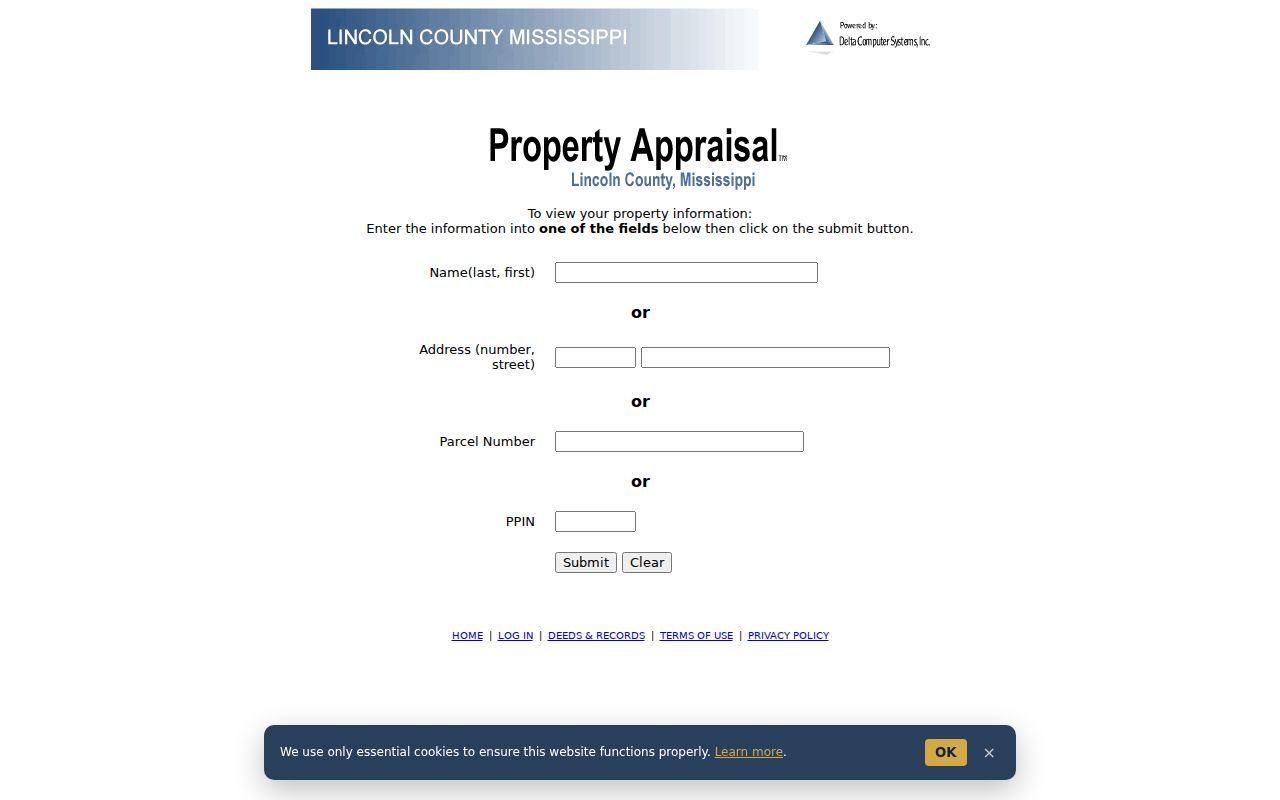
The screen is an entry form, nothing more. Treat it as a doorway to a parcel lookup rather than as evidence of any sample value.
Recorded Sale Price and Lincoln County Value
A deed's consideration may describe a transfer. But it can be absent, nominal, or bundled. It can also be shaped by family, estate, correction, or entity circumstances. Match the deed's date and legal description before setting it against the current assessment.
The Chancery Clerk indexes deed records by grantor, grantee, filing date, book and page, instrument number, subdivision, city-block-lot, and section-township-range. Images require Internet Record Room credentials or a request to the clerk. A recorded amount is history, not a current appraisal.
Brookhaven and Wesson Value Comparisons Need Boundaries
A Brookhaven label or ZIP proves little by itself. It does not establish city limits, tax districts, class, or a comparable market area. Wesson demands even more care, since the town straddles Lincoln and Copiah counties. Pin down the county and parcel number before comparing values.
Population counts and historic-property totals are not value trends either. Neither Brookhaven nor Wesson publishes a usable price time series. Those figures should never become appreciation claims.
Build a Lincoln County Property Value Comparison
A sound comparison starts with the same type of number for the same effective period. Match assessor true value against assessor true value, or assessed value against assessed value. Never line up a tax amount, a deed consideration, and an appraisal estimate. Those do not measure one thing.
For each parcel, record the PPIN, parcel number, situs, acreage, land and improvement fields when shown, class, exemption status, appraisal year, and taxing jurisdiction. Then test whether a split, new improvement, change of use, or corrected description explains a difference. The public portal offers no comparable-sales tool, so assume none.
Wesson parcels need a county-side check on top of everything else. Lincoln and Copiah rolls, millage rates, parcel schemes, and update dates can all differ. A shared town label cannot make two records comparable. Brookhaven comparisons likewise need the correct city-limit and taxing-district context before any conclusion holds.
When Deed Consideration Distorts Lincoln County Value
Recorded consideration can reflect a family transfer, estate distribution, partial interest, correction, entity reorganization, assumption, or nominal amount. Such deeds may be perfectly valid while saying nothing about an open-market sale. Read the instrument type, parties, legal description, and date before using the figure.
For older or image-restricted deeds, the Delta index supplies filing, party, book and page, instrument, subdivision, city-block-lot, and section-township-range leads. Scanned images require Internet Record Room credentials or a Chancery Clerk request. The index alone may not reveal every term needed to interpret consideration.
A licensed parcel-specific appraisal answers a different question than the assessor's mass appraisal. Keep those purposes distinct. That discipline protects any Lincoln County property value analysis from false precision.
Get Lincoln County Value Records Beyond the Web
The web portal only carries part of the story. When an entry looks wrong or thin, call the Tax Assessor directly. Blake Pickering's office sits at 301 South First Street, Room 109, in Brookhaven. The phone number is 601-823-9347. Ask about the record year and the classification. Ask about the valuation basis and any land or improvement figures the portal leaves out.
Two other courthouse offices round out the record. The Tax Collector handles the billed amount, payments, and any delinquency on a parcel. The Chancery Clerk holds the deeds. Each office keeps its own piece. Treat them as separate stops rather than one interchangeable source.
For a written request, be precise. Give the parcel number or PPIN and the year. Include the exact appraisal field you need and your preferred format. Mississippi's public-records framework allows offices to charge reasonable direct costs. Request an estimate before approving anything broad.
What Lincoln County Property Value Cannot Prove
The assessor's figure is a mass-appraisal number built for administration. It does not promise a sale price. It cannot settle a boundary, certify a building's condition, or stand in for a parcel-specific appraisal. Even the consideration stated in a deed says nothing about what the land would fetch on the market today.
Value vs price. A Lincoln County assessed value is used for taxation and is not a prediction of what the property will sell for or a licensed appraisal.
Match the number to the question. Keep its date attached. Name its source every time. That habit keeps assessed value, market estimates, tax amounts, and sale consideration from blurring into one misleading figure.
A purchase decision needs more than value records. Inspect the physical condition, the legal description, the current deed, the zoning context, and any recorded burdens. For an estate or a partial-interest transfer, the deed's terms can matter more than its stated consideration. For classification questions, ask the Assessor which facts place the parcel in its current class. Each of these checks answers a narrow question that no single value field can settle.
Label every column when you share a comparison. Source and year belong on each one. A reader should tell at a glance whether a figure came from the appraisal roll, the tax record, a deed, or an independent appraisal.